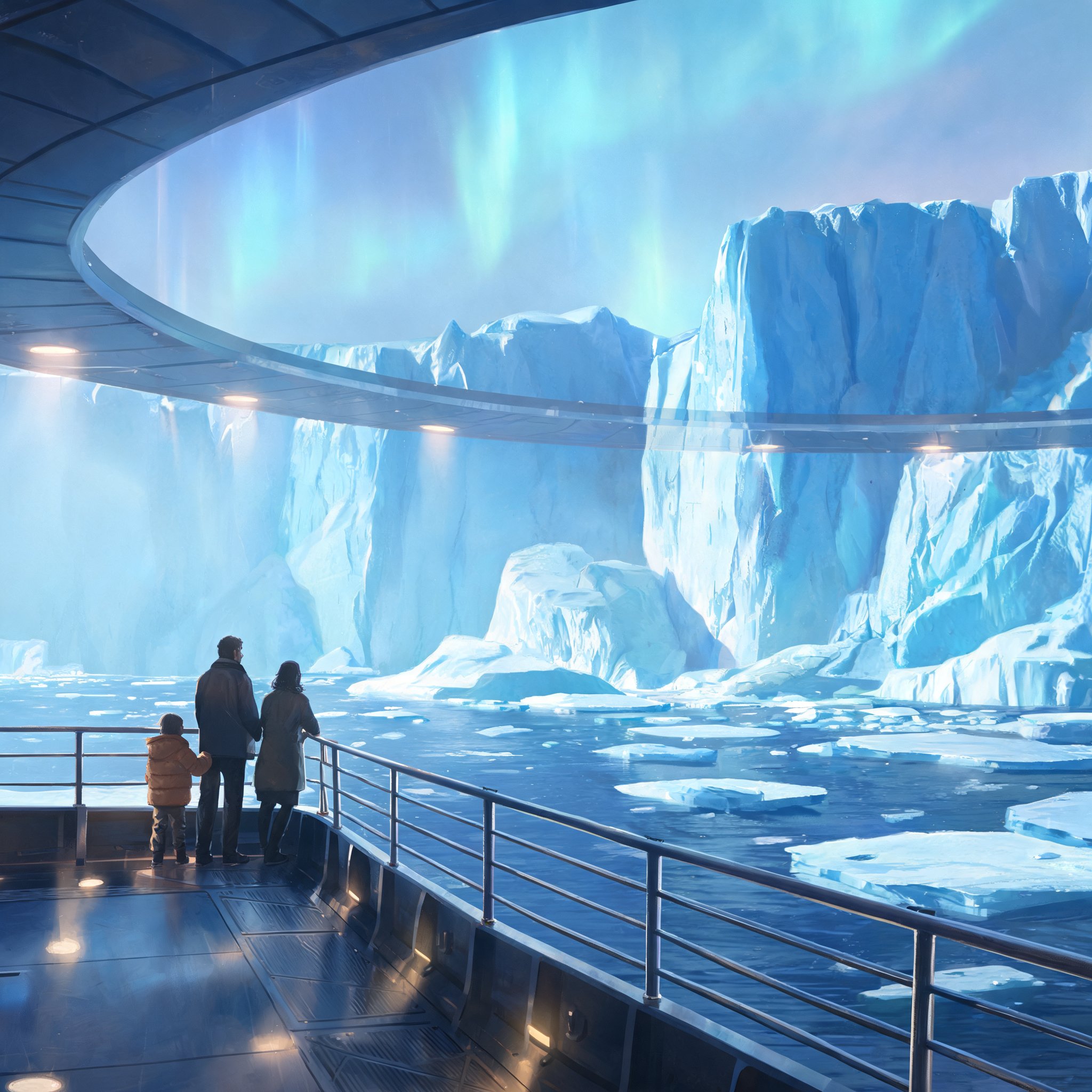
An immersive exhibition devoted to the Arctic and Antarctic welcomed more than 120,000 visitors in the four months following its world premiere in Berlin, according to dan pearlman, the studio that developed the concept and realisation. POLAR EXPERIENCE is presented by the Galileo and Galileo Kids brands and was conceived by Nicole Srock.Stanley.
The format is built on a single narrative device: visitors are enrolled as members of a modern polar expedition rather than treated as spectators watching one. According to the organisers, the aim was to convey climate change through the perspective of the scientists who study and work to protect the polar regions, instead of relying on facts and statistics alone.
From research vessel to 360-degree projection
The route begins with boarding the research vessel Polarstern, where visitors are received as expedition members before moving into the frozen landscapes of the Arctic and Antarctic. Along the way the exhibition presents large ice formations, polar wildlife, the lives of Indigenous communities and the scientific missions that have shaped current understanding of climate change. The journey culminates in a 360-degree projection environment that combines large-scale visuals, surround sound and choreographed storytelling.
Science as the starting point
The Alfred Wegener Institute, Helmholtz Centre for Polar and Marine Research, acts as scientific partner, and polar researcher Prof. Dr. Markus Rex is credited among the contributors to the content. NGOs including WWF Germany also supplied expertise. The organisers state that scientific accuracy was treated as the foundation of the visitor journey rather than an additional content layer, and that scientific input shaped the exhibition from its earliest stages instead of being adapted to a completed creative concept.
That interdisciplinary working method brought together scientists, filmmakers, Indigenous representatives, educators, media partners, designers and immersive technology specialists across the development process, according to the project description.
Optimism rather than fear
The exhibition deliberately avoids fear-based messaging, with the organisers describing curiosity, wonder and optimism as the intended drivers. A closing section titled "Act Now" sets out practical opportunities for climate engagement, partnerships and personal contribution, with the stated intention that visitors leave with a sense of responsibility and agency as well as new knowledge.
Accessibility and layered storytelling
A multilingual audio guide accompanies the full journey, and younger visitors are guided by Cosmo, a character from Galileo Kids, so that scientific topics are presented in a form children can follow. The organisers describe this as a layered approach that lets families, school groups and adults with differing levels of prior knowledge engage at their own level.
Partners and positioning
- Scientific partner: Alfred Wegener Institute, Helmholtz Centre for Polar and Marine Research
- Local promoters: FKP Scorpio Entertainment in Oberhausen; Cofo Entertainment in Berlin
- Media partner: Seven.One Starwatch, a subsidiary of ProSiebenSat.1 Media SE
- Sponsor: GLS Bank
Dan pearlman positions the project within an Innovation Award category, arguing that immersive media can function as an educational platform rather than a purely entertainment- or interpretation-led attraction. The studio's stated benchmark is that innovation should be judged by the ability to connect audiences emotionally with global challenges, not by technical sophistication alone.
The visitation figure, the media reception and the characterisation of the exhibition's educational effect are the organisers' own accounts; no independent audience research is cited in the project description.