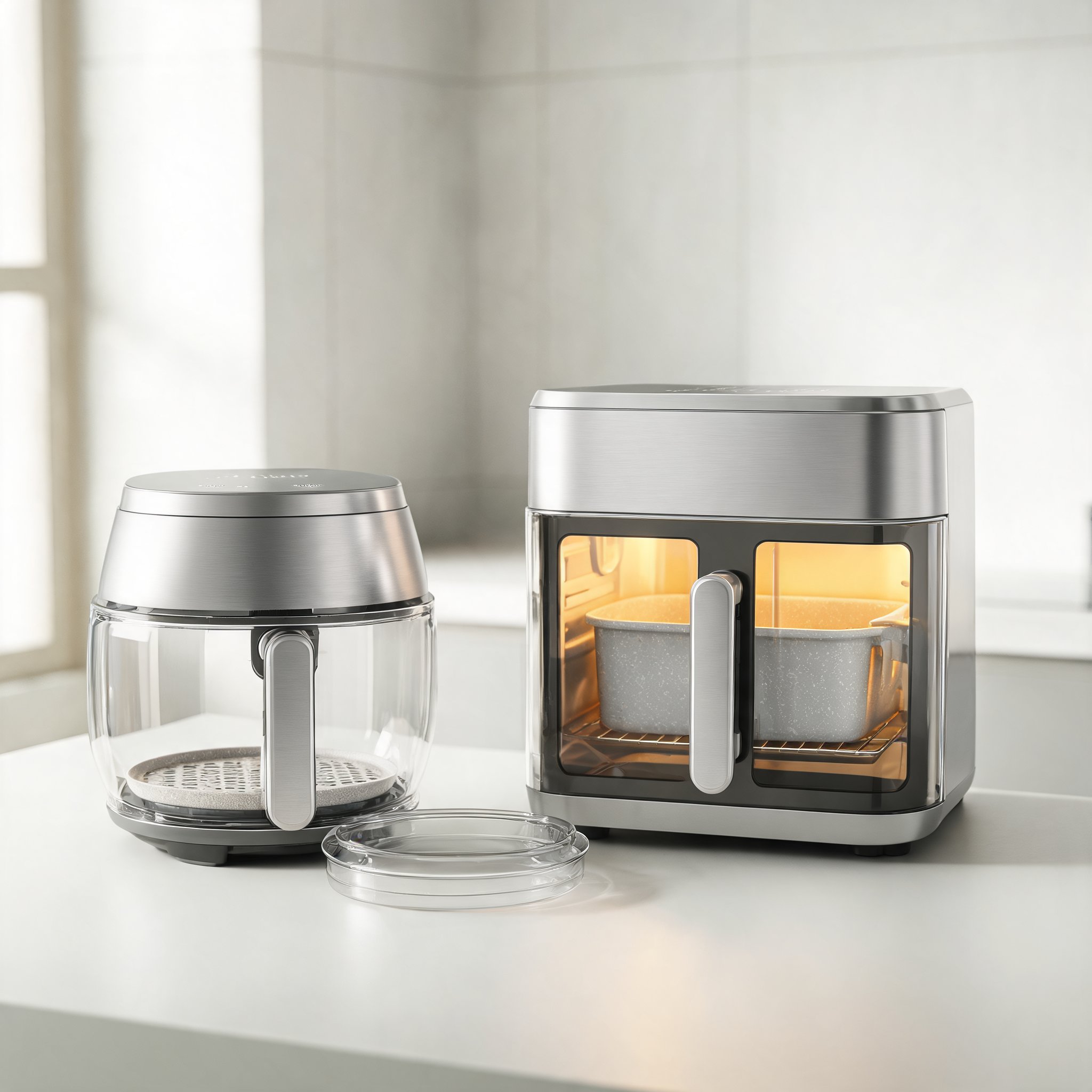
Cuisinart has expanded its air fryer lineup with the ClearView range, comprising a compact 3.8L Glass Air Fryer and a family-sized ClearView 9-in-1 8.5L Air Fryer. Both models are designed around visible cooking, with two viewing windows and interior lights that allow users to check progress without opening the drawer.
The 3.8L model cooks in a glass bowl that comes with a lid for storing leftovers. Both air fryers use removable PFAS-free ceramic-coated crisper plates, while the 8.5L version adds a PFAS-free ceramic-coated basket. Cuisinart says the dishwasher-safe parts are intended to simplify cleaning.
Both units deliver 1,800W of power, reach temperatures of up to 230°C and carry a three-year warranty. The 3.8L model offers Air Fry, Roast, Grill, Bake, Keep Warm and Recrisp settings, plus a function for saving a favourite recipe. The 8.5L model provides Air Fry, Roast, Grill, Max Crisp and Dehydrate settings, precise 5°C temperature adjustments and recipe saving.
Materials move into focus
Laura Conlon, Cuisinart’s head of marketing, described air fryers as a staple in Australian kitchens and said shoppers are now considering the materials used for cooking, not just size and speed. She added that the ClearView range gives them a reason to take a fresh look at the category, with two sizes suited to different households.
The Cuisinart ClearView 3.8L Glass Air Fryer and ClearView 9-in-1 8.5L Air Fryer are available at RRP $199 and $229 respectively. Cuisinart is selling them through appliance, kitchenware and specialist retail partners as well as directly.